
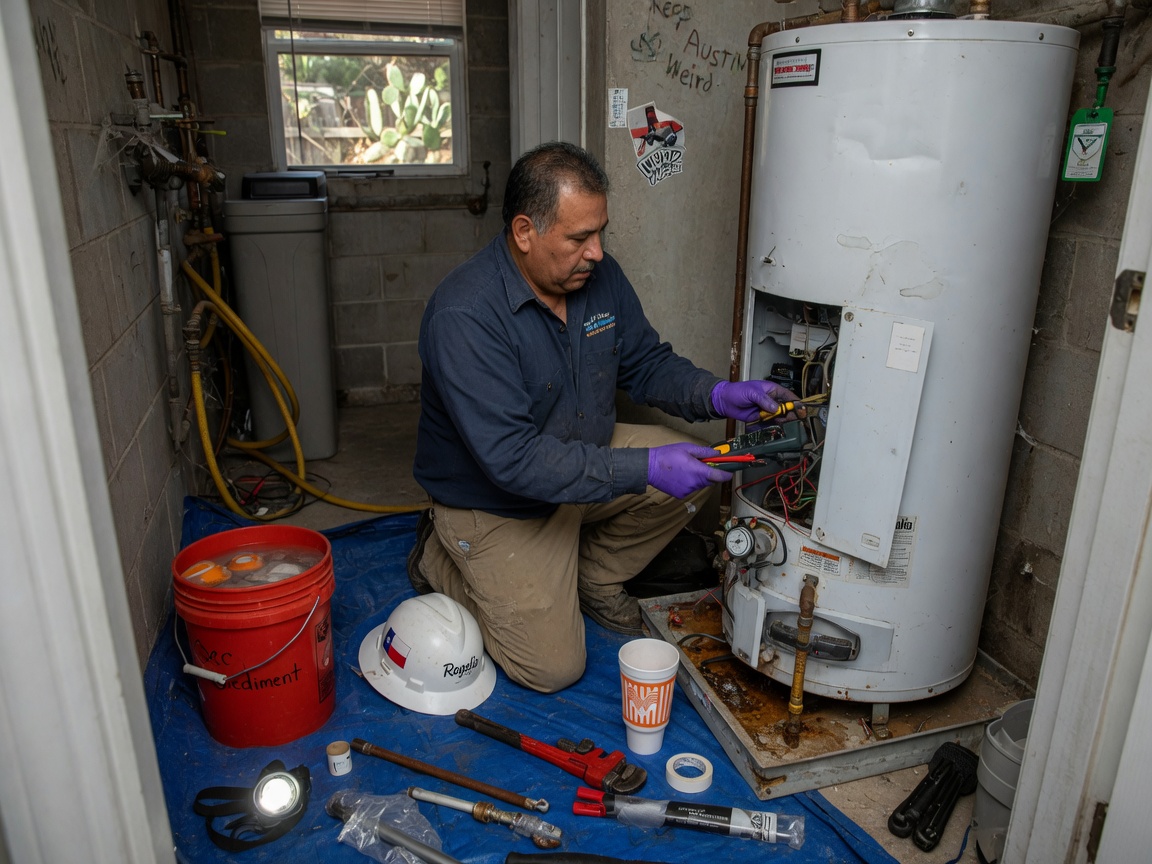
Austin's municipal water carries higher mineral content that accelerates sediment buildup inside tanks, especially in homes built before 1990 in Hyde Park and Clarksville. Skipping annual flushing lets scale insulate heating elements, driving up energy use during the long humid summers when households run hot water more often. Technicians drain tanks fully, clear the dip tube, and inspect the anode rod before refilling to restore efficiency without unnecessary replacement.
Mild winters in Travis County still produce enough temperature swings to stress older glass-lined tanks found in South Congress and East Austin bungalows. Corrosion often starts at the bottom seam or around the drain valve where standing water sits. During maintenance visits we test the temperature-pressure relief valve, check for leaks at connections, and note any expansion tank issues common on properties near Lady Bird Lake where soil movement is frequent.
Homeowners in Westlake and Barton Hills with tankless units still need periodic descaling because the same mineral-rich water leaves scale on heat exchangers. We isolate the unit, run a vinegar solution through the system, and verify flow rates match manufacturer specs. This step prevents the short cycling that appears after spring pollen and rain increase groundwater minerals entering city lines.
Service calls also cover nearby cities like Round Rock and Pflugerville where newer subdivisions still experience the same hard-water effects. We document model numbers, note installation dates, and advise on when a unit in a 20-year-old home is approaching the end of reliable service rather than pushing repairs that won't hold.
Technician insight
In Austin, the thing that catches most people out with Water Heater Maintenance is how quickly sediment builds in pre-1990 homes in Clarksville and Hyde Park because of Colorado River minerals, especially once the mild winters give way to humid summers that increase daily hot-water cycles and mask early efficiency loss.
Sediment Buildup in East Austin Bungalow
Homeowner in East Austin reported lukewarm water after several humid weeks. Inspection showed heavy mineral sediment at the tank bottom from local supply. We performed a complete flush, replaced the depleted anode, and recalibrated the thermostat. Hot water returned to full temperature and pressure without needing a new unit.
Water Heater Maintenance Services We Offer
✓Sediment Flushing Service
Full tank drain and sediment removal that restores heating efficiency in homes affected by Austin's mineral-heavy water supply.
✓Anode Rod Inspection and Replacement
Check and swap magnesium or aluminum rods to slow corrosion in older tanks common throughout Hyde Park and Clarksville.
✓Temperature Pressure Relief Valve Testing
Verify valve operation and replace if needed to meet safety standards on units installed in Travis County residences.
✓Thermostat and Element Calibration
Adjust settings and test electric elements or gas controls to prevent short cycling during peak summer demand.
✓Tankless Descaling Service
Vinegar flush of heat exchangers for tankless systems serving homes in Zilker and Mueller where hard water scale accumulates quickly.
✓Expansion Tank and Plumbing Check
Inspect expansion tanks and connections for leaks caused by soil movement near Barton Springs and Lady Bird Lake.
Water Heater Maintenance Cost in Texas
| Service | Typical Range | What Affects It |
|---|---|---|
| Standard Tank Flush and Inspection | $150–$275 | Higher end for units over 10 years old or limited access in older Hyde Park homes. |
| Anode Rod Replacement | $120–$220 | Varies by rod type and whether tank requires full drain. |
| Tankless Descaling | $200–$350 | Includes solution and flow testing; extra for multiple units. |
| TPR Valve Replacement | $95–$180 | Parts and labor; price rises with difficult valve location. |
Ranges are typical for Texas and confirmed with an exact written quote before any work starts.
How it works
- 1
Initial Assessment
Technician reviews unit age, model, and recent performance while noting neighborhood-specific water conditions.
- 2
System Isolation and Drain
Shut off water and power or gas, then drain the tank completely to access sediment layers.
- 3
Component Inspection and Service
Test valve, anode, elements, and connections, then perform flushing or descaling as required.
- 4
Reassembly and Verification
Refill, restore power or gas, check for leaks, and confirm proper temperature and pressure settings.
Pricing
Maintenance pricing depends on tank age, type, and access; most visits fall in the mid-range for Austin homes.