
2026-08-22 · Jim McGuiness
Are Tankless Water Heaters Worth It in Texas?
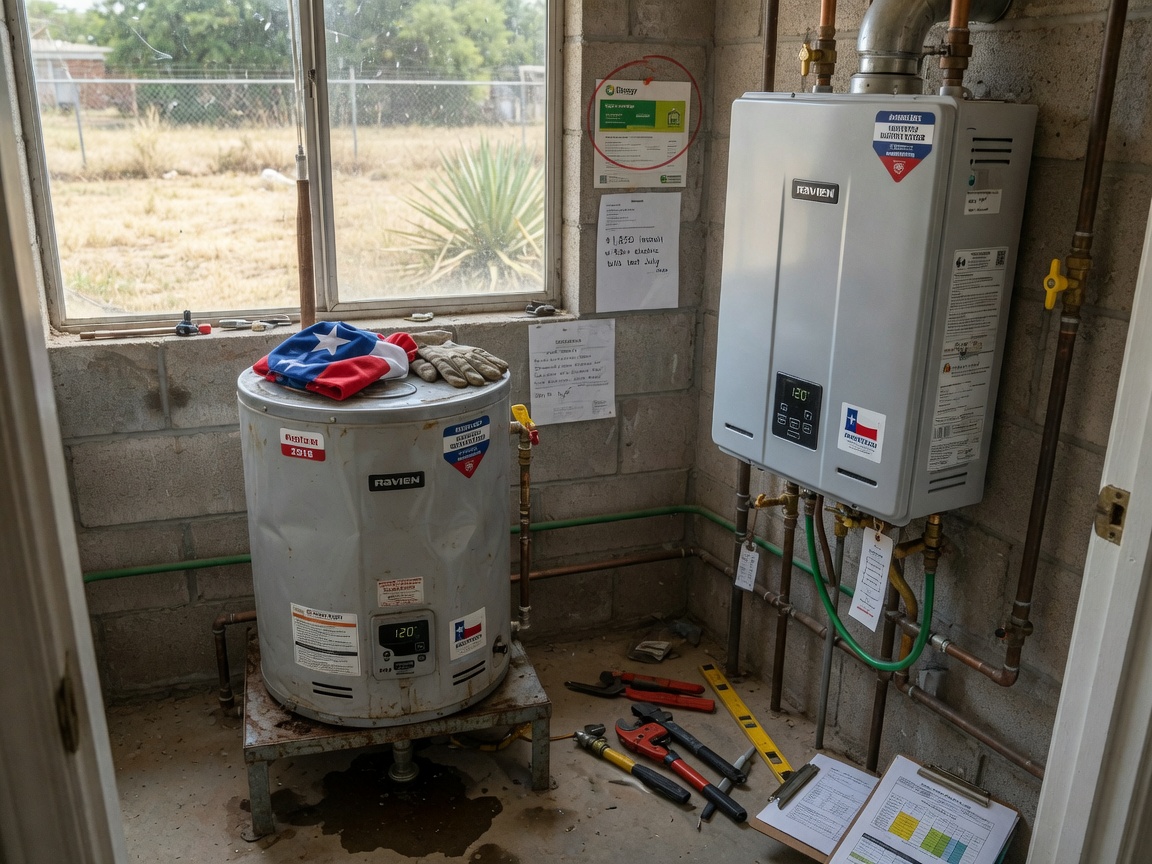
Tankless water heaters are worth it in Texas for Austin households using more than 40 gallons of hot water daily, delivering $100–$200 yearly energy savings after an initial outlay of $2,000–$4,000, though smaller homes in older stock often see longer payback periods.
Cost Analysis for Austin Homeowners
Austin homeowners replacing a standard 40- or 50-gallon tank unit face $1,200–$2,500 in removal and new tankless installation labor alone. In neighborhoods such as Hyde Park and Clarksville, where many 1920s–1950s homes have tight utility closets, crews often need to reroute gas lines or upgrade 3/4-inch supply piping, adding $400–$800. Newer builds in Mueller and Zilker Park allow easier retrofits because mechanical rooms were designed with future tankless capacity in mind. Over an 8–12 year lifespan, the efficiency edge of 0.82–0.95 UEF versus 0.60–0.70 for tanks produces measurable utility reductions once winter mild temperatures drop and spring wildflower season brings higher occupancy. Homeowners in Westlake and Barton Hills who already pay higher Travis County property taxes frequently prioritize the smaller footprint and endless hot water for guest suites.
Performance in Austin's Climate
Hot humid summers push groundwater temperatures into the low 70s, so tankless units rarely need to work at full 199,000 BTU capacity, extending component life. Mild winters with occasional 20-degree snaps still require proper freeze protection; units installed in East Austin crawl spaces or South Congress garages need insulated enclosures and heat-trace cable. Spring wildflower season brings pollen that can clog intake screens faster than in drier parts of the state, so quarterly checks become necessary. Residents in Round Rock and Pflugerville report that tankless models maintain steady 120-degree output even when multiple showers run simultaneously during peak summer humidity, unlike tanks that struggle after the first 40 gallons. The same performance holds in Cedar Park subdivisions where larger families exceed 80 gallons daily.
Suitability for Local Housing Stock
Travis County housing ranges from 1940s bungalows in Travis Heights to 2010s builds in the Domain area. Older homes often have 1/2-inch gas lines that limit tankless flow rates to 5–6 gallons per minute, requiring upsizing before installation. Newer Mueller and Zilker properties already sized for high-efficiency appliances accept 199,000 BTU units without modification. In Barton Hills and Westlake, where lots slope toward Lady Bird Lake, venting runs must clear roof peaks to avoid downdrafts during humid summer storms. Homeowners considering Tankless Water Heater Installation should verify existing electrical service if switching from gas to electric models, especially in Clarksville where historic district rules restrict exterior vent terminations.
Long-Term Value and Maintenance
A properly sized tankless unit lasts 15–20 years with annual descaling in Austin's moderately hard water. Skipping the yearly flush in homes near Barton Springs Pool, where mineral content runs higher, leads to flow-sensor failures within 5–7 years. Gas vs. Electric Water Heaters: Which Is Better? outlines the venting and condensate-drain differences that affect long-term costs. Lone Star Water Heater Pros remains available 24 hours, 7 days a week for emergency service calls when a unit faults during a cold snap. How Long Does Water Heater Installation Take? details the one-day timeline typical for most Austin retrofits once gas-line upgrades are complete.
Deciding Factors for Your Home
Measure peak simultaneous demand by running two showers and a dishwasher at once; if flow drops below 5 gallons per minute, a tankless unit sized at 7–9 gallons per minute is required. Homes in Downtown high-rises or Hyde Park cottages with limited utility space gain the most from wall-mounted units that free floor area. Larger families in Pflugerville and Cedar Park who already exceed 60 gallons daily see the fastest payback. When usage stays under 30 gallons, sticking with a high-efficiency tank remains more economical. Review your last 12 months of utility bills and compare the projected $100–$200 annual savings against the $2,000–$4,000 installed cost before deciding.